Radiation Hardness Assurance

Overview of Services

We offer comprehensive support for Radiation Hardness Assurance (RHA) and Qualification

request now

Our Services

Radiation Hardness Assurance

Electronic systems operating in radiation-intensive environments (space, nuclear, medical, aviation, automotive) need validated reliability against ionizing radiation effects. Seibersdorf Laboratories offers a complete suite of radiation effects services, from experimental testing to simulation, environment definition, and expert consulting.

Arrow left
Arrow right
TID Testing (Foto: Seibersdorf Labor GmbH)

Assessing Cumulative Radiation Effects for High-Reliability Electronics

Total Ionizing Dose (TID) Testing

When electronic components, printed circuit boards (PCBs), or systems are exposed to ionizing radiation over mission lifetimes — whether in space, nuclear facilities, medical environments, or other high-radiation settings — they accumulate Total Ionizing Dose (TID) that can degrade electrical and functional performance. Understanding and quantifying this cumulative radiation damage is essential to ensure reliability, inform design decisions, and mitigate risk. 

At Seibersdorf Laboratories, our TID testing services are built to provide precise, traceable, and internationally recognized results that support rigorous Radiation Hardness Assurance (RHA) programs and qualification paths for demanding applications. 

learn more

DD Testing (Foto: Seibersdorf Labor GmbH)

Why Displacement Damage Matters

Displacement Damage (DD) Testing

Evaluating Structural Damage from Non-Ionizing Radiation for Reliable Electronics

Displacement Damage (DD), also known as Total Non-Ionizing Dose (TNID), describes the permanent structural damage that energetic particles such as protons and neutrons inflict on semiconductor lattices. This process alters the crystal structure of devices, increasing defects and degrading electrical performance over time. DD is particularly relevant for:

  • Optoelectronics, photodiodes, and imaging sensors
  • High-reliability analog circuits
  • Spaceborne electronics exposed to trapped protons and cosmic neutrons
  • Nuclear and accelerator environments where neutron flux is significant
  • Semiconductor technologies with sensitive minority carrier properties 

Understanding and quantifying displacement damage is crucial for predicting lifetime performance, designing mitigation strategies, and supporting formal Radiation Hardness Assurance (RHA) and qualification activities.

learn more

SEE Testing (Foto: Seibersdorf Labor GmbH)

Heavy Ion & Laser Simulation — Detect & Quantify Particle-Induced Failures

Single Event Effects (SEE) Testing

In modern high-reliability electronics, Single Event Effects (SEE) — transient or destructive events triggered by energetic particles such as heavy ions and protons — pose a fundamental challenge. These effects can manifest as bit flips, latch-ups, transients, or functional interruptions that impact system functionality, reliability, and mission success. SEE testing is therefore a critical pillar of Radiation Hardness Assurance (RHA) for aerospace, defense, semiconductor, automotive, and other radiation-sensitive industries. 

At Seibersdorf Laboratories, we deliver advanced, standards-aligned SEE testing services — combining heavy ion exposure, laser-based stimulation, and expert analysis — to help you understand, mitigate, and design against radiation-induced single event effects. 

learn more

Simulation (Foto: AdobeStock)

Predict, Model & Validate Radiation Interactions for Mission Assurance

Simulation & Space Radiation Environment Definition

When developing electronics and systems for space, aerospace, nuclear, and high-reliability applications, understanding how radiation interacts with matter is not just beneficial — it’s essential. Experimental testing provides real results, but simulation and environment definition maximize confidence, enhance test planning, and reduce risk across the entire development lifecycle.

At Seibersdorf Laboratories, our simulation and environment definition services combine high-fidelity Monte Carlo modeling, mission-specific radiation profiles, physics-based transport calculations, and standards-aligned methodologies to support design, shielding, qualification, and risk mitigation objectives.

learn more

Beratung Consulting (Foto: Seibersdorf Labor GmbH)

Guidance Across Your Radiation Hardness Assurance (RHA) Lifecycle

Consulting & Expert Support

Developing, qualifying, and assuring electronic systems for radiation-challenging environments — whether for space missions, aerospace, nuclear, medical, automotive, or industrial applications — can be complex. Radiation effects span Total Ionizing Dose (TID), Displacement Damage (DD), Single Event Effects (SEE), and environment definition; navigating test standards, qualification paths, and mitigation strategies requires deep expertise and practical experience. 

At Seibersdorf Laboratories, our Consulting & Expert Support services are designed to be your trusted partner throughout the entire RHA process — from initial planning to final interpretation and decision-making — helping you translate complex technical data into actionable insights and qualified decisions that drive project success. 

learn more

Details about the Individual Services

More about Total Ionizing Dose (TID) Testing

What is TID testing?

Total Ionizing Dose (TID) testing evaluates how the energy deposited by ionizing radiation - predominantly gamma photons from sources such as Cobalt-60 — affects materials, components, and circuits over time. Even if a device still functions, TID can cause subtle shifts in parameters such as threshold voltage, leakage current, gain, timing, or noise, which over long exposures can impact reliability or functional margins. 

TID tests are especially critical for:

  • Space missions and satellites
  • Nuclear power and research installations
  • Medical imaging and radiotherapy electronics
  • Aerospace and industrial safety-critical systems
  • High-reliability automotive and avionics applications 

Our TID Testing Capabilities

Accredited TEC Laboratory

Our TEC Laboratory on the Tech Campus Seibersdorf, Austria is a Co-60 gamma irradiation facility fully accredited to EN ISO/IEC 17025 — the international benchmark for competent and traceable testing. It is one of the premier TID facilities in Central Europe and is dedicated to TID testing of components, systems, and materials. 

Key features of our TID exposure facility include: 
• High-activity Cobalt-60 irradiation source with a dose rate range of 0.3 Gy/h to 50 Gy/h (30 rad(Si)/h – 5 krad(Si)/h), covering both low dose rate and standard dose rate windows specified in ESCC-22900. 
• Spacious, homogeneous exposure room enabling uniform irradiation of multiple devices and assemblies. 
• Pneumatic system for precision source movement and exposure control. 
• Automatic data logging of dose, dose rate, environmental parameters, and facility access to ensure traceability and repeatability. 
• High-quality multichannel dosimetry for accurate dose measurement and monitoring. 
• Attached multifunctional electronics laboratory for in-situ or remote electrical measurements during irradiation. 

We provide 24/7 testing services for:

  • Components (discrete devices, ICs, memories)
  • PCBs and assembled modules
  • Subsystems and complete devices
  • Structural materials and packaging interfaces 

TID Test Standards and Compliance

Our TID testing procedures are aligned with the most widely accepted international standards, ensuring that results are qualification-ready and compatible with agency and industry expectations

Standards we adhere to include:

  • ESCC Basic Specification No. 22900 – Total Dose Steady-State Irradiation Test Method 
  • ECSS-Q-ST-60-15 – Radiation Hardness Assurance Requirements for Space Projects 
  • MIL-STD-750, TM 1019.5 – Steady-State Total Dose Irradiation Procedure 
  • MIL-STD-883, Method 1019.9 – Ionizing Radiation (Total Dose) Test Procedure for Microcircuits 

These standards define:

  • Dose rate windows
  • Electrical measurement checkpoints
  • Biasing conditions during exposure
  • Reporting and data handling requirements

This alignment makes our TID data directly consumable for qualification, lot acceptance testing, safety cases, and design verification. 

Why TID Testing Matters to You

Modern electronics — especially those using advanced semiconductor nodes or mixed signal functions — are increasingly sensitive to cumulative radiation damage. Accurate TID characterization helps you:

  • Determine parametric degradation trends under realistic exposure scenarios. 
  • Validate design margins against mission or lifetime dose profiles. 
  • Inform shielding, redundancy, or mitigation strategies early in development. 
  • Ensure mission success and safety for space, nuclear, medical, and industrial applications. 

By quantifying how a device’s key electrical parameters drift or fail as dose accumulates, you can make confident decisions about part selection, derating, and system resilience.

Case Studies & Proven Experience

As an illustration of our TID testing capabilities, we present exemplary TID testing from two two operational amplifiers, tested within the ESA CORHA study for radiation screening of commercial off-the-shelf components for the space industry. 

The components underwent rigorous testing in our TEC Laboratory Seibersdorf to assess its performance under ionizing radiation. 

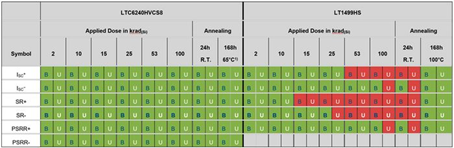
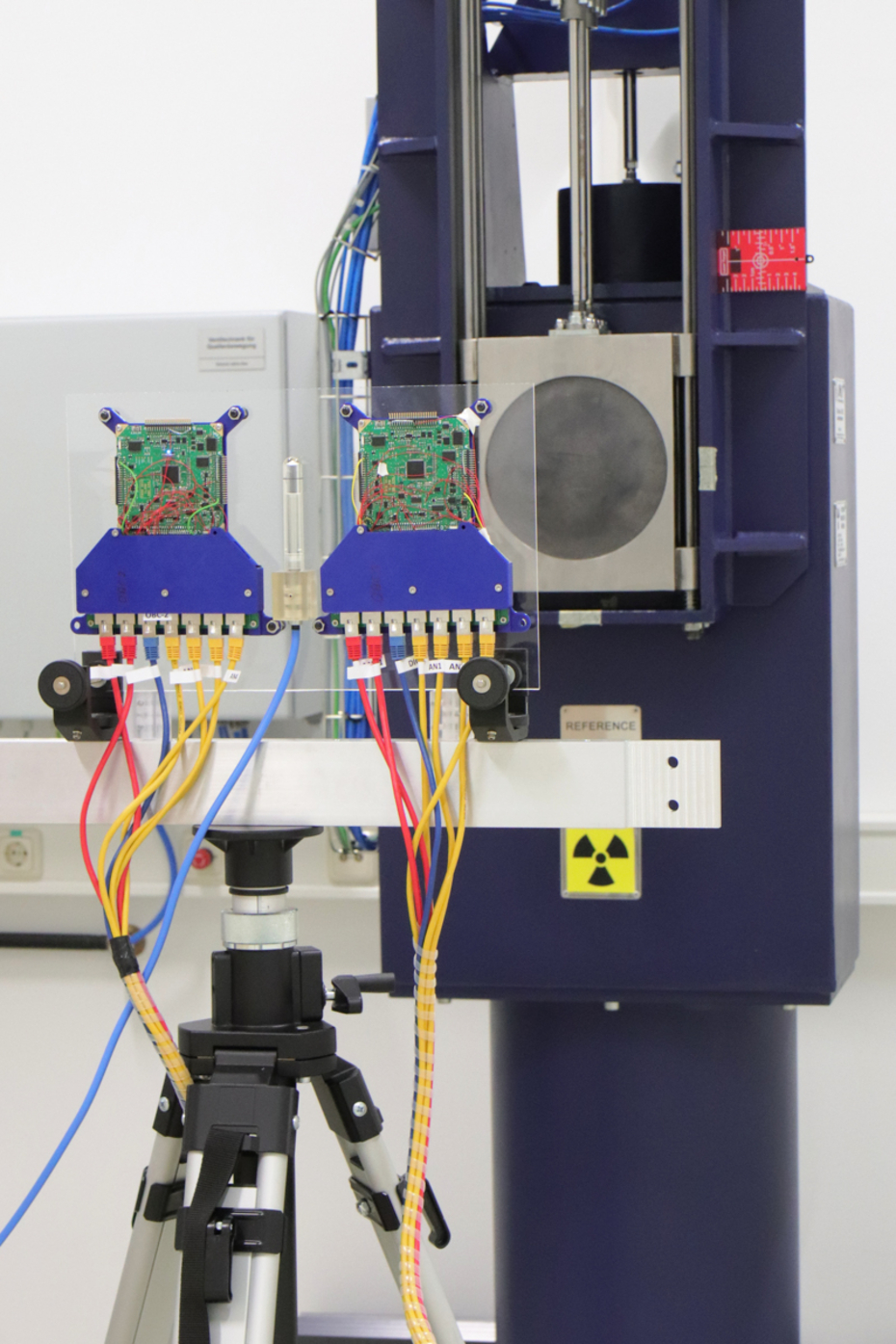
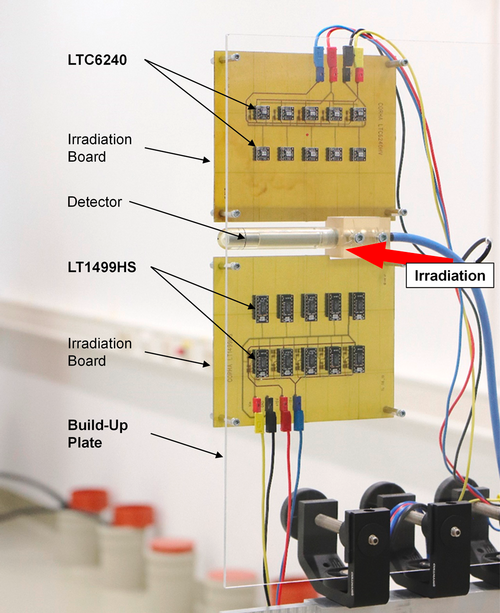
Co-60 TID exposure set-up of COTS operational amplifiers LTC6240HVCS8 (upper PCB) and LT1499HS (lower PCB). Within the ESA CORHA project, both devices were irradiated in six exposure steps to a total dose of 100 krad(SI) in the TEC Laboratory Seibersdorf.
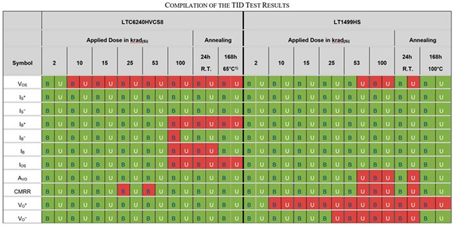
A green cell color indicates that all biased (B) and unbiased (U) devices are within the specification limits, otherwise the cell is marked red.

1) 168 hours annealing is performed at 65°C in order not to exceed the maximum guaranteed operating temperature of 70°C specified in the device's datasheet.
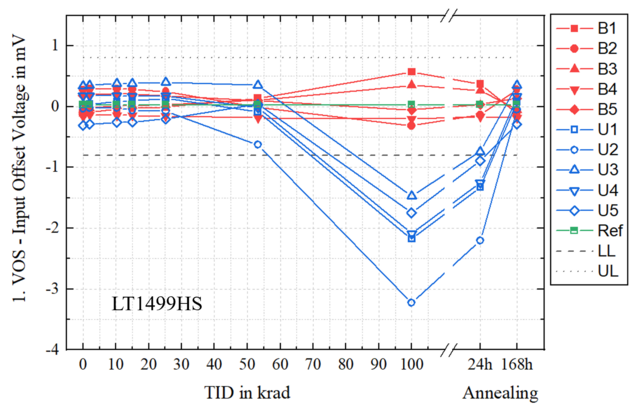
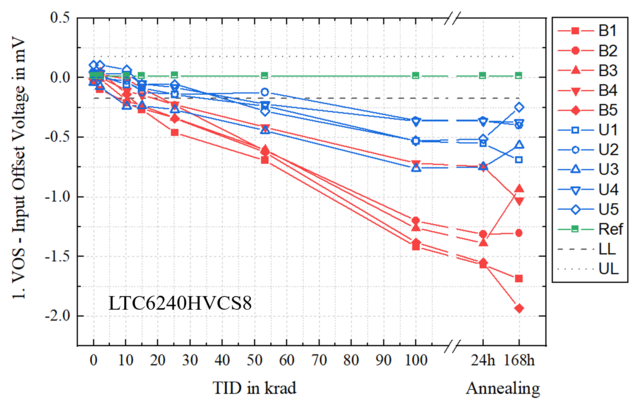
Degradation of the input offset voltage VOS of the LTC5240HVCS8 (left) and LT1499HS (right) COTS operational amplifiers as a function of dose and after 24h and 168h annealing. 
Biased devices in red, unbiased devices in blue, and the non-irradiated reference device in green. ​​​​​​​
Lower (LL) and upper (UL) limits as specified in the test plan in dashed and dotted lines, accordingly.


Reference

C. Tscherne et al., “Testing of COTS Operational Amplifier in the Framework of the ESA CORHA Study,” 2020 20th European Conference on Radiation and Its Effects on Components and Systems (RADECS), Toulouse, France, 2020, pp. 1-7, doi: 10.1109/RADECS50773.2020.9857692.

Our TID Testing Services

We tailor TID testing to meet your technical and program goals:

  • Comprehensive TID Radiation Exposure
  • Parametric and Functional Characterization
  • Reporting & Qualification Support
  • Expert Interpretation & Consulting

Partner With Us

Whether you are developing flight hardware for a space mission, qualifying electronics for nuclear environments, or ensuring long-term terrestrial reliability, our Total Ionizing Dose Testing services provide the data and insight you need for informed decisions and robust design validation.

Seibersdorf Laboratories offers accredited infrastructure, experienced engineers, and industry-aligned test methods that give you meaningful, traceable, and qualification-ready TID results you can rely on. 

Get Started

Contact us to discuss your component, board or system TID testing needs, receive a tailored test plan, and learn how our radiation hardness assurance services help you achieve mission success and design assurance.

contact us

Details about Displacement Damage (DD) Testing

Comprehensive DD Testing Services Tailored to Your Needs

At Seibersdorf Laboratories, we provide a full suite of Displacement Damage (DD) testing services designed to deliver high-quality, traceable, and actionable data to support your component qualification, design validation, and reliability assurance programs. 

Custom In-House Test Preparation

A successful DD campaign starts long before irradiation. Our experienced team collaborates closely with you to:

  • Define radiation damage objectives aligned with mission or operational profiles
  • Develop custom test fixtures and DUT (Device Under Test) configurations
  • Establish electrical biasing, temperature conditions, and measurement protocols
  • Prepare robust test plans that reflect your reliability and qualification goals 

We take pride in managing these preparatory phases in-house, ensuring high fidelity between your technical requirements and the subsequent irradiation execution. 

Precision Irradiation via Partner Facilities

For the controlled delivery of displacement damage, we coordinate testing at strategically selected partner irradiation facilities equipped with:

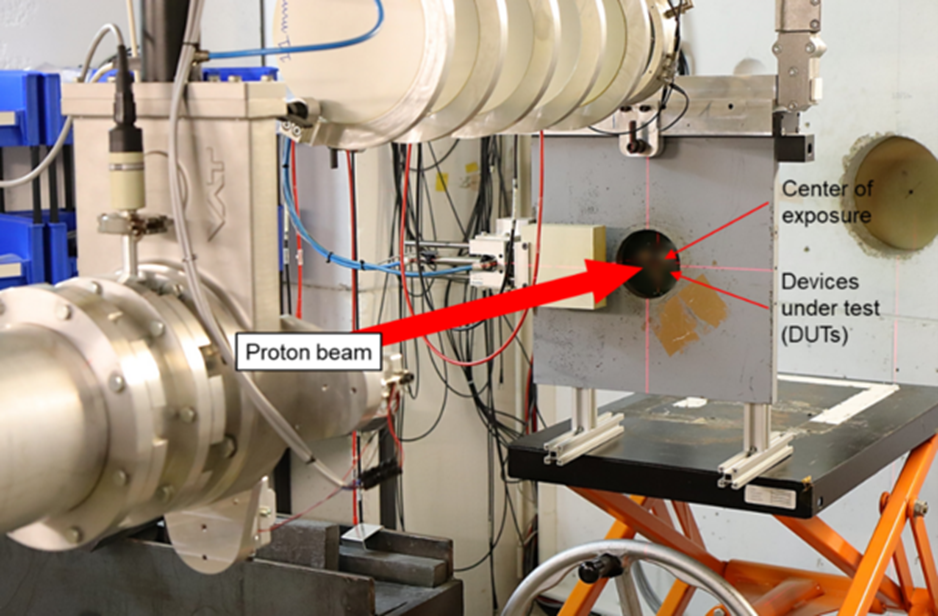
  • Proton beams that produce displacement damage through Coulombic and nuclear interactions
  • Neutron sources that generate atom displacements without significant ionization dose

This enables a realistic reproduction of particle types and energies relevant to:

  • Low Earth Orbit (LEO) and planetary missions
  • Nuclear research and power systems
  • Aerospace and defense environments
  • High-reliability terrestrial applications 

We manage the coordination of beam time, DUT preparation, and logistics so that you benefit from seamless test execution with consistent quality assurance across facilities. 

Standards Compliance and Industry Alignment

Our DD testing framework adheres to internationally recognized standards, ensuring your data is reliable, comparable, and qualification-ready:

  • ESCC 22500 – Displacement Damage Irradiation Test Guidelines (primary scope for proton/neutron DD) 
  • MIL-STD-883, Method 1017 – Neutron Irradiation for Microelectronic Devices 

These standards define critical aspects of a DD campaign such as fluence levels, energy spectra, electrical measurement protocols, test environment conditions, and documentation practices. Adherence to these ensures that your results are robust and compatible with space, defense, and industrial qualification frameworks. 

What You Get: Accurate Performance Degradation Characterization

Our DD testing services deliver:

Quantitative Assessment of Device Degradation

We measure key parameters such as:

  • Gain and responsivity loss in photonic and optoelectronic devices
  • Leakage and noise increases in analog circuits
  • Threshold shifts in semiconductor junctions
  • Parameter drift in sensors and detector systems 

These measurements reveal how displacement damage impacts device behavior and allow you to:

  • Predict performance over operational lifetime
  • Validate design margins and derating strategies
  • Benchmark part selection for radiation tolerance
  • Feed data into reliability and lifetime models 

Application Areas and Use Cases

Displacement Damage testing is essential when your system must operate reliably in:

Space Electronics
Protons and cosmic neutrons can drive displacement damage in:

  • Solar cells and imaging sensors
  • Transceivers and power electronics
  • Mixed-signal circuits
    Ensuring these components meet mission lifetime requirements is key for satellites and deep-space probes.

Nuclear Systems
Neutron flux in reactor environments can degrade control, safety, and monitoring electronics. DD testing provides insight into how systems will age under long-term exposure.

Semiconductor Manufacturing
As device nodes shrink and transistors become more susceptible to structural disruptions, DD data informs process choices, mitigation designs, and radiation risk assessments.

Aerospace & Defense
High-altitude avionics and defense platforms encounter displacement damage mechanisms that can compromise signal integrity or sensor performance without mitigation.

Our Process: From Setup to Insight

Our DD testing service includes:

  1. Tailored Test Planning
    We begin with a technical consultation to capture your objectives, application environment, and expected radiation profile.
     
  2. Test Setup Development and Qualification
    Custom fixtures, biasing schemes, and environmental controls are designed in-house to fit your test plan.
     
  3. Controlled Irradiation Execution
    Using partner facility beam time, we expose DUTs to defined displacement damage doses with precise fluence and energy distribution.
     
  4. Electrical & Functional Characterization
    Post-irradiation measurements are conducted to track parameter shifts and identify failure modes.
     
  5. Comprehensive Reporting
    Actionable results are delivered in a detailed test report, including:
    • Test conditions, particle energy spectra, and fluence data
    • Pre/post irradiation parameter comparison
    • Correlation with applicable standards and qualification criteria

Partner With Us for DD Confidence

Displacement Damage is one of the key radiation effects that can silently undermine electronic performance. At Seibersdorf Laboratories, our expertise, meticulous preparation, and commitment to standards compliance ensure that your DD testing supports:

  • Accurate prediction of operational performance
  • Risk-informed design decisions
  • Qualification evidence for mission assurance
  • Integration into broader RHA strategies 

We serve clients across space, nuclear, aerospace, industrial, and semiconductor sectors — delivering results that help you engineer with confidence in radiation-challenging environments. 

Get Started

Discuss your DD testing needs with our experts today. We will help you:

  • Define a radiation displacement damage test plan
  • Understand expected effects on your devices
  • Integrate DD data into your qualification and design strategy

Contact us for a tailored consultation and take the next step toward proven radiation resilience.

to contact

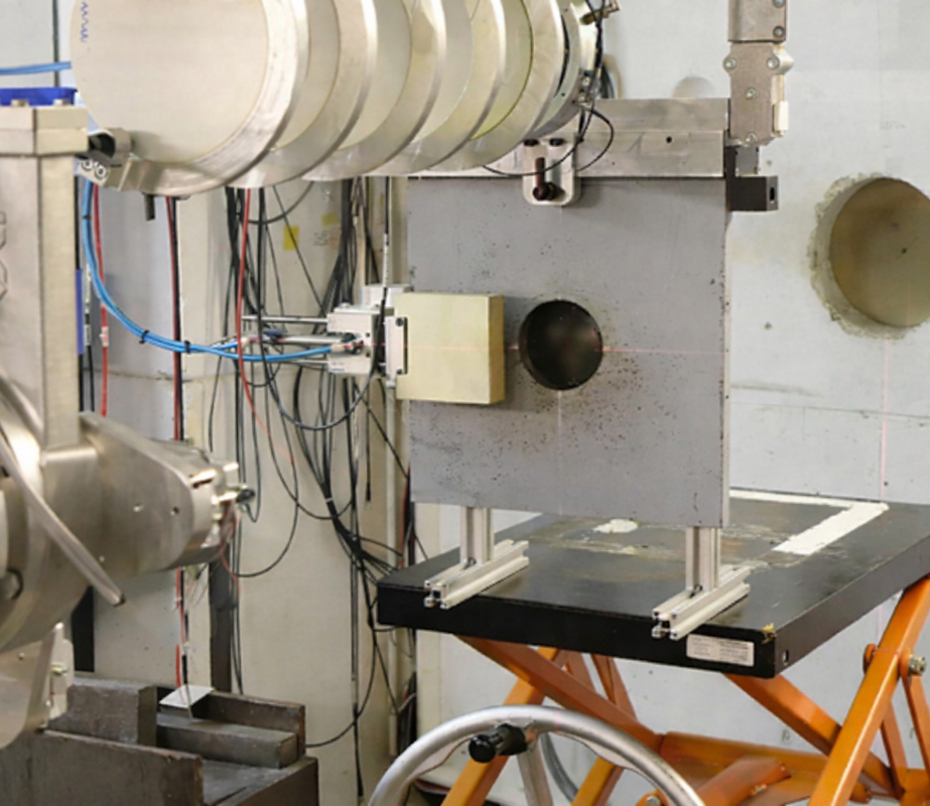
Displacement damage exposure set-up. The DUTs are exposed to a defined displacement damage dose and tested for parameter degradation.

Details about Single Event Effects (SEE) Testing

What Are Single Event Effects (SEE)?

Single Event Effects occur when a single energetic particle — most commonly a heavy ion or high-energy proton — deposits charge as it traverses a semiconductor. The deposited charge can disturb logic states, trigger latch-ups, or cause transients that interrupt normal operation. SEE mechanisms include:

  • Single Event Upset (SEU): Data corruption or bit flips
  • Single Event Latch-up (SEL): Destructive current states
  • Single Event Transient (SET): Temporary signal disturbances
  • Single Event Functional Interrupt (SEFI): System level resets or hang-ups

Understanding and quantifying these effects using controlled testing is essential to support soft error rate (SER) estimation, mitigation strategy design, and system-level reliability validation. 

Our SEE Testing Services

1. Heavy Ion SEE Testing

Heavy ion testing using high-energy particle beams remains the gold standard for evaluating single event effects in semiconductor devices. At Seibersdorf Laboratories, we manage and execute heavy ion SEE testing with the following capabilities:

  • Access to partner irradiation facilities equipped with heavy ion and proton beams tailored to generate a wide range of Linear Energy Transfer (LET) values.
  • Cross-section measurement and rate prediction for SEU, SEL, and SET mechanisms as functions of LET and particle fluence.
  • Standards-aligned protocols based on ESCC, JEDEC, and MIL-STD frameworks.

These campaigns provide the quantitative data you need to estimate in-orbit or in-field event rates, support design mitigation decisions, and validate reliability claims. 

Standards Compliance for Heavy Ion Testing

Our heavy ion SEE testing procedures are aligned with internationally recognized standards, including:

  • ESCC Basic Specification No. 25100 — Single Event Effects Test Methods and Guidelines
  • EIA/JEDEC EIA/JES57 & JESD89 — Measuring and Reporting Single Event Effects in Semiconductor Devices
  • MIL-STD-750, Procedure 1080 — Single Event Burnout (SEB) and Single Event Gate Rupture (SEGR) testing

Standards alignment ensures that your SEE test data is defensible, comparable, and suitable for qualification documentation across aerospace, defense, and industrial qualification frameworks. 

2. SEE Laser Testing — In-House High-Resolution Analysis

In addition to traditional accelerator-based particle testing, we offer SEE laser testing — a versatile and efficient method for stimulating single event effects with precise spatial and temporal control. Laser-induced testing plays a key role in modern RHA because it:

  • Simulates ionizing interactions at specific locations within semiconductor structures using pulsed high-energy lasers.
  • Provides high spatial resolution SEE mapping to identify vulnerable circuit nodes.
  • Enables rapid design-level screening and fault localization without the need for accelerator scheduling.
  • Offers fast turnaround and development times for early prototype evaluation. 

How Laser SEE Testing Works

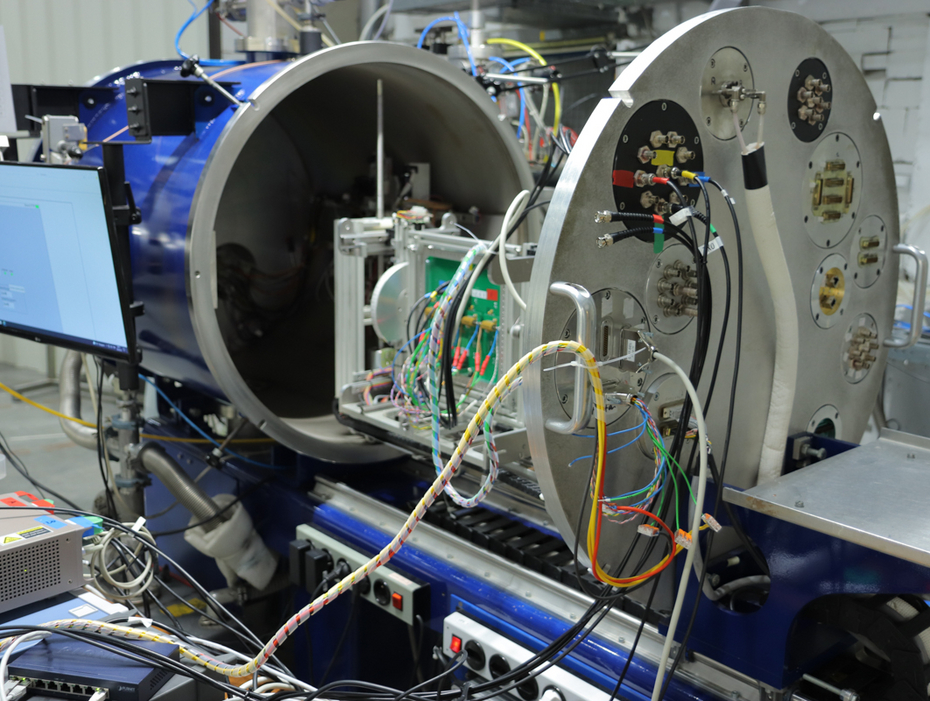
Laser pulses are directed at defined regions within the Device Under Test (DUT), generating localized charge carriers that mimic the effects of energetic particles. The resulting transient responses are captured and analyzed to reveal SEE susceptibility:

  • Preparation: DUTs are mounted and positioned for laser access.
  • Pulse Generation: Laser system creates short, high-energy pulses with precise intensity control.
  • Irradiation & Monitoring: Pulses are applied at target locations; sensitive events (SEU, SEL, SET) are detected in real time.
  • Analysis: Spatial mapping and temporal analysis yield insights into the physical locations and mechanisms of SEE vulnerabilities. 

Laser SEE testing complements heavy ion testing by offering high accessibility, rapid feedback, and detailed vulnerability mapping, reducing development risk and accelerating qualification loops. 

In-House Test Preparation & Customization

Our commitment to quality begins with in-house test preparation:

  • Custom test setups tailored to your specific devices, biasing conditions, and measurement needs.
  • Expert collaboration with your engineering teams to align test protocols with your technical and qualification goals.
  • Implementation of high-performance detection systems based on FPGA architectures providing nanosecond-scale event capture, configurable to your application. 

Comprehensive Testing Solutions Across Applications

We provide flexible SEE testing solutions that meet the needs of diverse industries and use cases:

  • Aerospace & Space Electronics: 
    Validate soft error rates for mission profiles and orbit radiation environments.
     
  • Defense & Avionics: 
    Assess latch-up robustness for safety-critical systems.
     
  • Semiconductor Manufacturers:
    Generate SEE sensitivity data for new process nodes and product lines.
     
  • Industrial & Automotive:
    Quantify transient event susceptibility in high-reliability systems subject to terrestrial cosmic rays or mixed radiation fields. 

Our goal is to deliver accurate, actionable data that informs design decisions, enhances mitigation strategies, and ensures your products meet reliability expectations in radiation-rich environments. 

Outcome - What You Gain

When you engage Seibersdorf Laboratories for SEE testing, you benefit from:

  • Actionable SEE Data
    Quantitative cross-section curves, event rates, and LET response plots that support risk assessment and mitigation planning.
     
  • Soft Error Rate (SER) Estimation
    Reliable SER models based on heavy ion and laser data, tailored to your environmental profiles.
     
  • Functional Reliability Insights
    Identification of vulnerable nodes and failure modes that inform architectural and design-for-reliability decisions.
     
  • Standards-Ready Reporting
    Comprehensive reports aligned with ESCC, JEDEC, and MIL-STD criteria, suitable for qualification reviews, audits, and customer documentation.

Partner With Us for SEE Readiness

At Seibersdorf Laboratories, our SEE testing services are engineered to help your team design, qualify, and deliver robust electronics capable of enduring transient radiation effects. With deep expertise, flexible methodologies, and standards-compliant procedures, we are your trusted partner in addressing the challenges of single event effects across mission-critical applications. 

Contact us today to discuss your SEE testing needs, explore laser vs. heavy ion strategies, and obtain a tailored test plan that aligns with your product goals and qualification requirements.

Details about Simulation & Space Radiation Environment Definition

Why Simulation Matters for Radiation Hardness Assurance

Simulations allow you to:

  • Predict radiation energy deposition and secondary particle cascades inside complex geometries.
  • Evaluate shielding effectiveness across layered materials and structural layouts.
  • Generate mission-relevant environmental spectra that feed directly into test plans.
  • Reduce the number of costly experimental iterations by guiding test parameter selection.
  • Validate ground test assumptions against realistic orbital or operational conditions.

By integrating simulation early in your design and RHA process, you gain visibility into radiation effects before hardware is built, and you align your analysis with qualification needs and standards. 

Space Radiation Environment Definition

Understanding the intricacies of the space radiation environment is paramount for the success of space missions and the reliability of electronic components and systems operating in space. At Seibersdorf Laboratories, we offer comprehensive services to define and analyze the space radiation environment, ensuring that your projects are equipped to withstand the challenges of space radiation.

Support of Relevant Standards

Our space radiation environment definition services adhere to industry-standard guidelines, including ECSS-E-ST-10-04 (Space environment) and ECSS-E-ST-10-12 ​​​​​​​(Methods for the calculation of radiation received and its effects, and a policy for design margins). These standards provide a framework for assessing the space radiation environment and establishing design margins to mitigate radiation effects on spacecraft and payloads.

Radiation Environment Analysis for Space Missions

We conduct thorough radiation environment analyses tailored to the specific requirements of your space mission. Our services include:

  • Determination of the radiation environment for the given orbit and mission duration.
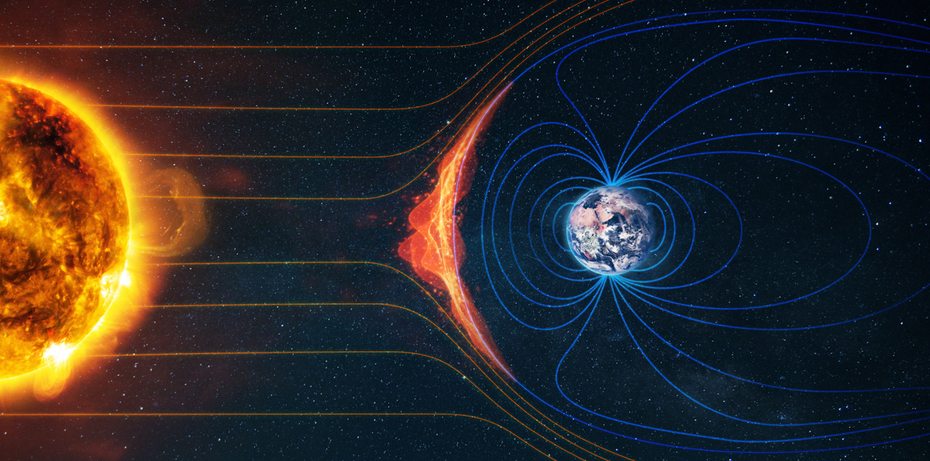
  • Consideration of dominant radiation contributions, such as solar radiation, cosmic radiation, and radiation in the Earth's magnetic field.
  • Utilization of models that comply with the guidelines of ESA ECSS standards to ensure accuracy and reliability.

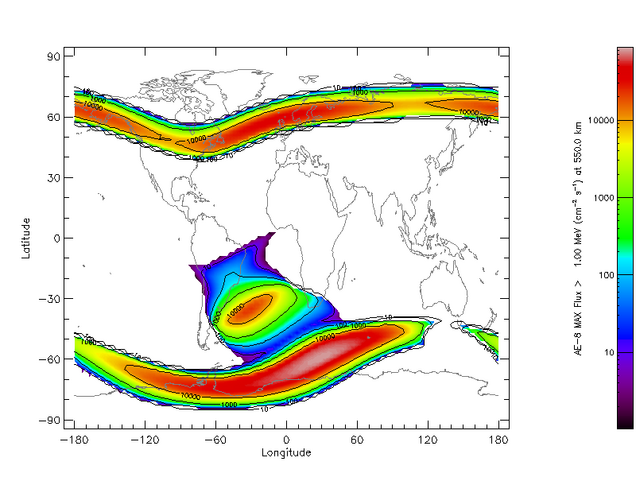
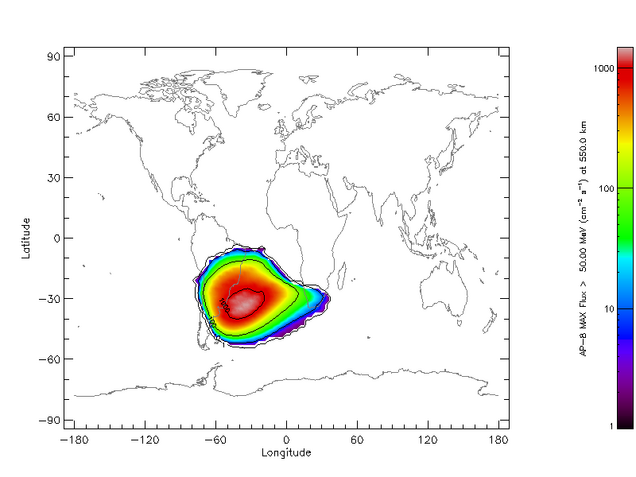
World map of trapped proton (left) and trapped electron (right) flux at a typical 550 km LEO orbit simulated with SPENVIS in compliance with ECSS standard models.


Analytical Approaches

Based on the fluxes and fluences derived for various radiation contributions, we perform detailed analyses to assess the impact of space radiation on your mission. Our analyses include:

  • Total Ionizing Dose (TID) as a function of shielding depth: 
    Evaluating the cumulative ionizing radiation dose absorbed by materials and components within the spacecraft.
     
  • Total Non-Ionizing Dose (TNID) or Displacement Damage (DD) as a function of shielding depth: 
    Assessing the effects of non-ionizing radiation on spacecraft materials.
     
  • Single Event Effect (SEE) analysis in the form of spacecraft-shielded Linear Energy Transfer (LET) spectra:
    Characterizing single radiation events on electronic components within the spacecraft.

Expert Guidance and Insights

Our team of radiation experts provides expert guidance and insights throughout the space radiation environment definition process. We work closely with clients to interpret analysis results, identify potential risks, and develop mitigation strategies to enhance mission success and ensure the reliability of space systems.

With Seibersdorf Laboratories as your partner, you can trust our expertise and commitment to excellence in defining and analyzing the space radiation environment for your space missions. Contact us today to learn more about our services and how we can support your next venture into space.

Monte Carlo & Advanced Radiation Transport Modeling

Simulation at Seibersdorf Laboratories leverages state-of-the-art radiation transport codes — the same class of tools trusted by space agencies, research laboratories, and aerospace integrators worldwide. 

GEANT4 — Particle Transport & Interaction Modeling

GEANT4 (Geometry And Tracking 4) is a powerful, object-oriented Monte Carlo toolkit widely used for high-fidelity simulation of particles (photons, electrons, protons, heavy ions, neutrons) interacting with matter. It supports:

  • Accurate propagation through 3D geometries
  • Physics models for electromagnetic and hadronic interactions
  • Customizable physics lists for space, medical, and high-energy applications
  • Detailed output on energy deposition, secondary particle distributions, and dose maps 

We use GEANT4 to model scenarios such as shielding penetration, secondary cascade effects, fluence and dose deposition in electronics, and mission-specific environmental exposures.

FLUKA — High-Performance Particle Transport Cross-Validation

The FLUKA code complements GEANT4 by offering alternative hadronic models and optimized simulations of complex radiation fields, particularly when benchmarking or extending high-energy physics scenarios. Its integration ensures broader confidence in model predictions and sensitivity analyses. 

Get Started with Simulation & Environment Definition

Discuss your radiation modeling and environment definition needs with our experts today. We’ll help you:

  • Define your mission’s radiation environment
  • Select the optimal modeling approach (MC simulations, shielding analysis, etc.)
  • Integrate simulation outputs into your test and qualification strategy
  • Interpret results to support design, mitigation, and submission packages

Contact Seibersdorf Laboratories to elevate your radiation assurance strategy, reduce program risk, and achieve mission success.

to contact

Details on Consulting & Expert Support

Why Expert RHA Consulting Matters

Radiation Hardness Assurance goes beyond running tests — it’s about understanding how radiation interacts with your specific design, how test results relate to real operational environments, and how to make informed engineering and program decisions based on that understanding. Consulting helps you:

  • Define a mission-aligned test strategy
  • Interpret complex radiation test results
  • Clarify compliance with ECSS, ESCC, MIL-STD, and other standards
  • Plan mitigation strategies that reduce risk and cost
  • Navigate qualification roadmaps from components to systems 

Our consulting services are built on decades of hands-on RHA experience and a deep understanding of both experimental and numerical methods used across industries. 

Our Consulting Services

Personalized RHA Guidance & Strategy

We start by listening — understanding your application, risk profile, mission requirements, and schedule constraints — then tailor our recommendations to your project needs. Whether you are exploring a new qualification path or refining an existing one, we provide structured guidance that aligns with your goals. 

We help you with:

  • Clarifying which radiation effects matter most for your application
  • Prioritizing tests and analysis based on mission risk and exposure
  • Aligning test strategies with client-specific performance objectives

Test Plan Definition

A well-structured test plan is a foundation for qualified results and confident decisions.

Our support includes:

  • Establishing clear test objectives based on your mission and system requirements
  • Defining radiation environments, dose and fluence profiles, and thresholds
  • Outlining execution steps, including sequencing, bias conditions, and acceptance criteria
  • Linking test plans to standards and qualifying bodies (e.g., ESA, aerospace primes) 

With expert test plan definition, you avoid unnecessary cycles, improve test relevance, and focus resources where they deliver value most.

Test Result Interpretation & Technical Insights

Radiation test outputs — TID curves, SEE cross-sections, parameter drift plots — contain rich technical data that can be difficult to interpret, especially when decisions have real program impact.

Our experts help you:

  • Decode test outputs and parameter trends
  • Relate data to system-level reliability and mission risk
  • Translate test findings into design recommendations
  • Benchmark results against standards and historical performance metrics 

This service turns raw measurement data into decision-ready insights you can act upon.

Qualification Roadmapping

Moving from component screening to system-level acceptance requires a clear roadmap.

Our services include:

  • Prioritizing critical milestones
  • Mapping component to subsystem and system qualification paths
  • Aligning qualification activities with international standards (ECSS, ESCC, MIL-STD)
  • Supporting documentation for reviews and certification boards

A well-structured qualification roadmap reduces rework, accelerates reviews, and improves your program’s overall predictability. 

Standards & Compliance Guidance

International test standards and frameworks can be complex. We provide clarity on the standards that apply to your RHA program and help you navigate them confidently.

Common areas of standards guidance include:

  • ECSS and ECSS-E-ST series — space engineering and radiation assurance
  • ESCC Basic Specifications for TID, DD, and SEE
  • MIL-STD test methods (e.g., for radiation effects)
  • Reporting structures and acceptance criteria consistent with agency and prime contractor expectations

We help interpret the standards in the context of your use cases, aligning your workflow and documentation to meet technical and contractual obligations. 

Dedicated Support Throughout the RHA Lifecycle

At Seibersdorf Laboratories, we see consulting not as an isolated service, but as continuous partnership throughout your RHA lifecycle. From the first discussion about your requirements to final analysis, reporting, and qualification decision support, we aim to be a trusted extension of your team. 

What You Can Expect:

  • Tailored and personalized guidance aligned to your technical and business needs
  • Clarity in complex decision points with expert interpretation
  • Support that reduces risk and accelerates project delivery
  • Actionable recommendations that inform engineering and program choices

Need Guidance? We’re Here to Help

Whether you’re:

  • Planning your first radiation test program,
  • Evaluating ambiguous results,
  • Negotiating compliance with multiple standards,
  • Or defining a path to system-level acceptance

our consulting services are designed to give you confidence and clarity at every step.

Seibersdorf Laboratories brings decades of RHA expertise, rigorous analytical capabilities, and a customer-centric approach to your project — making us your preferred partner for navigating the complexities of radiation assurance. 
Get in Touch

Contact us to discuss your unique challenge, request tailored consulting support, and discover how we can help you achieve reliable, qualified performance in radiation environments.

Seibersdorf Laboratories — Your Trusted Partner in Radiation Hardness Assurance Consulting.

contact us

Contact Us

Talk to us about your specific challenge, request personalized consulting support, and learn how we can help you develop reliable and qualified systems for high-radiation environments.

Seibersdorf Laboratories – Your trusted partner for radiation hardness assurance consulting.

contact us

ePortal Login

Digital service platform for simple and clear document management in radiation protection.

Login
Academy Login

Course booking platform - book courses online!

Login
Website Login

Protected area for authorized users.

Login