Radiation Services & Products

Aircrew Dosimetry Service for Airlines

Legally Compliant Determination and Reporting of Radiation Exposure for Flight Crew.

request now

Evaluation of cosmic radiation exposure

Aircrew Dosimetry Services

Seibersdorf Laboratories provides airlines with an accredited aircrew dosimetry service for the compliant determination, evaluation, and documentation of cosmic radiation exposure of flight personnel, in accordance with national and European radiation protection regulations.

Aircrew dosimetry refers to the systematic calculation and assessment of radiation exposure of pilots and cabin crew caused by cosmic radiation at cruising altitude. It is based on internationally recognized calculation models and - where required - complemented by measurement methods.

Our services support you in:

  • complying with legal requirements in accordance with EU Directive 2013/59/EURATOM and national radiation protection legislation 
  • accurately determining the annual radiation dose of your crew members 
  • ensuring traceable and transparent documentation of exposure data 
  • fulfilling reporting and information obligations towards authorities 
  • providing enhanced protection for pregnant crew members

With strong scientific expertise, validated models, and many years of experience in ionizing radiation and dosimetry, we are your reliable partner for radiation protection in aviation.

What is Flight Dosimetry?

Flight dosimetry refers to the systematic identification, calculation and evaluation of the radiation exposure of flying personnel (pilots, cabin crew and possibly frequent flyers) to cosmic radiation during flight operations. It is based on recognized calculation models and - if necessary - supplementary measurements. The purpose is to determine the effective dose absorbed by high-altitude radiation at cruising altitude in accordance with the law. Flight dosimetry is an essential component of operational radiation protection for airlines.

Why is cosmic radiation relevant for flying personnel?

At high altitudes, the protection provided by the Earth's atmosphere decreases - as a result, the intensity of ionizing cosmic radiation is significantly higher than on the ground. This radiation consists of high-energy particles and secondary particles that are produced when penetrating the atmosphere. While passengers are only exposed for a short time, flight personnel are repeatedly and regularly exposed to high doses of radiation. Even comparatively moderate annual doses represent a relevant factor for radiation protection.

Typical dose ranges — with specific figures

  • At cruise altitude, radiation exposure is typically 1 to 10 µSv per flight hour — depending on route, flight altitude and latitude.
  • A transatlantic flight can generate around ~100 µSv (0.1 mSv) in effective dose.
  • Average annual doses for flight personnel are often in the range of 2 mSv to 5 mSv per year, depending on flight profiles and flight times.
  • In extreme cases or on very many long-haul flights, values may be higher; this is why reporting and monitoring obligations apply in Europe starting at around 1 mSv per year.

By way of classification: Natural radiation exposure on the ground due to cosmic radiation is on average around 0.3 mSv per year, combined with terrestrial radiation, a total of around 2 — 3 mSv/year for the general population.

Difference: radiation exposure on the ground vs. at flight altitudes

situationTypical effective dose
On the ground (cosmic)~0.3 mSv/year
Flight altitude (~10 km) per hour~1 — 10 µSv/h
Transatlantic flight~0.1 mSv
Aircrew annually~2 — 5 mSv/year


At high altitudes, atmospheric protection is lower and the Earth's magnetic field less effective — as a result, radiation exposure increases significantly compared to the ground. The aircraft shell offers only limited shielding against this high-altitude radiation.

Influencing factors: solar activity, latitude & flight altitude

The actual radiation exposure depends on several physical factors:

Flight altitude: Higher flight altitudes mean less atmospheric protection — and therefore higher radiation rates.

Latitude: In polar regions, geomagnetic protection is lower than at the equator, which results in higher doses.

solar activity:

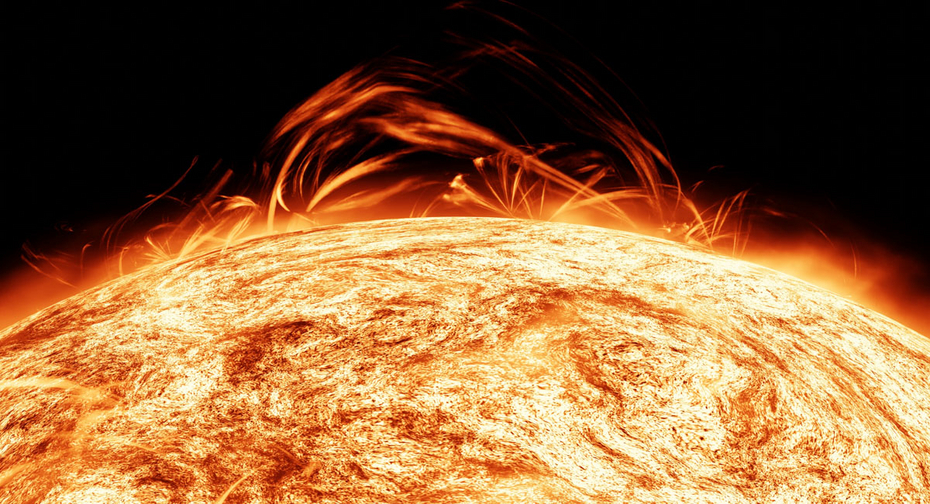
  • During high solar activity, the radiation rate at flight level can fall due to modulated galactic radiation,
  • Severe solar particle events can result in significantly increased doses for a short time.

These factors make flight dosimetry complex: Calculation models and software solutions must take them into account in order to provide accurate dose determinations.

Why is basic knowledge important?

Understanding flight dosimetry is crucial for airlines to meet their legal obligations in radiation protection, to assess risks for crew members and to plan effective protective measures. Regular dose assessments support compliance, safety and transparency vis-à-vis authorities and employees.

Who is affected?

Exposure to cosmic rays affects all people who regularly fly at high altitude. It is therefore crucial for air carriers to know which groups of people fall under radiation protection surveillance.

Pilots

Due to their regular stays at cruising altitudes of 8,000 to 12,000 meters, pilots are among the most exposed professional groups in civil aviation.

Depending on flight profile, area of operation and annual flight time, effective annual doses in the range of 2 to 6 mSv can occur.

This means that pilots are often above the threshold of 1 mSv per year, above which mandatory dose assessment is required in accordance with EU radiation protection legislation.

cabin crew

Flight attendants are also exposed to increased cosmic radiation during every flight.

Especially during intensive long-haul missions, the annual doses can be in the same range as for pilots.

For air carriers, this means that
cabin crew should generally also be regarded as a professionally exposed group of people and included in the systematic dose calculation.

Crew on long-haul and polar flights

Long-haul flights result in longer exposure times per operation.

Flights over high latitudes (e.g. North Atlantic or polar routes) also have higher dose rates, as geomagnetic protection is lower in these regions.

Crew members on such routes therefore often reach higher annual doses than colleagues in short-haul operations.

Precise dose calculation is therefore particularly relevant for airlines with an intercontinental route network.

Suborbital flights and new forms of flight

The development of new commercial flight concepts — such as suborbital flights or extremely high-flying business aircraft — raises additional issues relevant to radiation protection.

At higher altitudes, radiation intensity continues to rise.

Companies that use or plan innovative flight profiles should check at an early stage what radiation protection requirements result from this.

Pregnant employees — special protection

One particularly sensitive area concerns pregnant crew members.

As soon as a pregnancy is reported, stricter protection requirements apply. According to radiation protection legislation, the dose of the unborn child must not exceed 1 mSv for the remaining period of pregnancy.

A transparent and timely dose assessment is therefore essential in order to:

  • to fulfill the legal protection mandate
  • make appropriate deployment adjustments
  • to ensure legal certainty for employers and employees

Professional flight dosimetry provides the necessary basis for decision-making here.

When is reporting mandatory?


The 1 mSV threshold — regulatory trigger in the EU

In the European Union, the radiation protection basis is regulated by Directive 2013/59/Euratom.

For air carriers, as soon as the effective annual dose of crew members reaches or exceeds 1 millisievert (1 mSv), binding obligations arise for dose determination and monitoring.

This requirement has been implemented in national law both in Austria and in Germany.

Guidance for airlines: Do your crews reach 1 mSv per year?

For many airlines, the question is not whether cosmic radiation is relevant — but which crew groups are affected.

The network diagram for dose determination provided by us (1 mSv) provides a quick, practical classification. It shows which combinations of flight hours, flight altitude and route reach the relevant threshold of 1 mSv per year under radiation protection law.

The diagram takes into account:

  • The annual flight hours of a crew group
  • The typical cruise altitude
  • the route network (equatorial, central European or polar routes)

This makes it possible to quickly identify whether parts of your flight operations fall within an area that requires systematic and documented dose assessment.
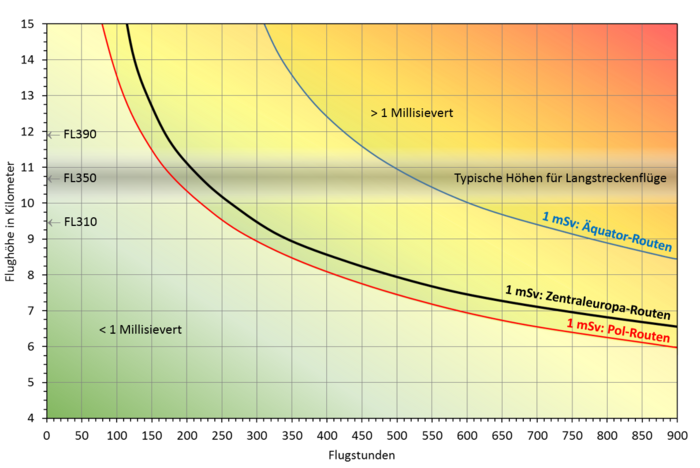
 

Guidance for airlines: Do your crews reach 1 mSv per year?

If the graph shows that certain cockpit or cabin crews could reach or exceed the range of 1 mSv per year, a well-founded, accredited dose assessment is required to:

  • to comply with legal obligations
  • to create internal transparency
  • Implement protective measures correctly
  • to assess special situations (e.g. pregnancy) in a legally secure manner

The network diagram gives you the first reliable orientation. 
The legally binding dose calculation is then carried out by an accredited testing body.


Austria

Legal Basis:

  • Radiation Protection Act (StrSchG)
  • General Radiation Protection Ordinance (AllgStrSchV)

If aircrew is expected to reach or exceed 1 mSv per year, the company must:

  • carry out a systematic dose assessment
  • document exposure
  • Inform affected persons
  • define necessary protective measures

The competent authority is the Federal Ministry for Climate Protection (BMK) or the respective competent radiation protection authority.

Germany

Legal Basis:

  • Radiation Protection Act (StrlSchG)
  • Radiation Protection Ordinance (StrlSchV)

Here too, the 1 mSV threshold is considered a decisive trigger.

Companies must:

  • Determine the dose of the flying crew
  • document the results
  • If the threshold is exceeded, implement appropriate protective measures
  • Retain records and present them for regulatory review

In Germany, the respective state authorities are responsible for radiation protection.

For internationally operating airlines, this means that even with an identical EU legal framework, administrative reporting and documentation processes differ between Austria and Germany.

EU-wide flight operations

Since the EU Directive has been implemented in all Member States, the following applies throughout Europe:

  • The 1 mSV threshold is decisive
  • Dose assessment is mandatory if this value can be achieved
  • There are documentation and information requirements

When deploying crew members across borders, airlines must ensure that dose values are determined and managed consistently and in accordance with the law.

Dose monitoring requirement

If the 1 mSV threshold is reached or can it be reached, continuous and verifiable dose determination is required.

This comprises:

  • Determination of the individual effective annual dose
  • Consideration of flight hours, flight altitude and route profile
  • Continuous update in case of changes in flight operations
  • special evaluation in case of pregnancy

Monitoring is not a one-off process, but part of a lasting radiation protection concept.

Documentation requirement

In both Austria and Germany, the dose values determined must:

  • comprehensibly documented
  • stored for defined periods of time
  • made available to affected employees
  • be presented during regulatory checks

Missing or inadequate documentation can be considered a violation of radiation protection obligations.

Update requirement

The exposure assessment should be regularly reviewed and adjusted, in particular in the case of:

  • Change of route network
  • Introduction of new aircraft types
  • Adjustment of cruise altitudes
  • Change in crew planning
  • new regulatory requirements

In practice, regular reassessment is recommended — particularly in the event of structural changes in flight operations.

Conclusion for airlines

If aircrew reaches or exceeds the threshold of 1 mSv per year, the result is:

  • Dose determination requirement
  • Obligation to monitor
  • Documentation requirement
  • Duty to provide information
  • Where applicable, reporting obligation to authorities

For airlines with intensive short-haul, long-haul or polar routes, this threshold is often reached faster than expected.

Well-founded, accredited dose assessment creates legal certainty in Austria, Germany and throughout the EU area.

An overview of our service

Holistic flight dosimetry solutions for airlines

We support you in meeting the radiation protection requirements for flying personnel in a legally compliant, efficient and comprehensible manner. Our service covers the entire process — from precise dose determination and continuous monitoring to individual advice in complex cases.

Your benefits at a glance:

  • Legal security through accredited solutions
  • Saving time through professional processing
  • Independent expertise with many years of experience
  • Reducing regulatory risks
Arrow left
Arrow right
Avidos (Foto:Adobestock)

Online dose calculation based on science

AVIDOS

AVIDOS is a web-based tool for calculating cosmic radiation exposure for any flight routes and flight altitudes. The software is based on extensive simulations and real measurement data and was developed in collaboration with the European Space Agency ESA.

In addition to the publicly available version for general use, Seibersdorf Labor GmbH also uses AVIDOS within an accredited framework for legally valid dose determination for air carriers.

Your advantage:

  • Scientifically based calculation basis
  • Web-based application for flexible analyses
  • Use within the framework of our accredited testing center
  • Legally compliant dose calculation in accordance with national and EU requirements

AVIDOS thus combines ease of use with regulatory reliability — from quick orientation to officially recognized dose determination.

epcard (Foto:Adobestock)

Officially approved dose calculation

EPCARD.Net

EPCARD.Net is a proven software for precise calculation of the cosmic radiation dose over flight routes at flight altitudes between 5,000 m and 25,000 m. It has been approved by the German Federal Aviation Office (LBA) for official dose calculation for flying personnel.

Your advantage:

  • High-quality dose determination based on the latest scientific findings
  • Offline and stand-alone operation possible
  • Can be perfectly integrated into your business processes
  • Full data sovereignty within your own company
Weltraumstrahlung (Foto:Adobestock)

Space weather service for civil aviation (ICAO/UN)

PECASUS

PECASUS is the European consortium designated by the International Civil Aviation Organization (ICAO) — a specialized agency of the United Nations (UN) — as a global Space Weather Service Center. The aim is to support airlines worldwide with operationally usable information during heavy solar activity — especially where space weather can influence flight safety and flight operations.

Seibersdorf Labor GmbH is part of PECASUS and contributes its expertise in the areas of space radiation/radiation exposure at flight altitudes and its effects on humans and avionics.

Your benefits as an airline:

  • ICAO-compliant space weather advisories for aviation (e.g. on increased radiation exposure at flight altitudes, GNSS interference, RF communication)
  • More decision-making certainty with increased solar activity (route, altitude, communication, navigation)
  • Reducing operational and regulatory risks through ICAO-compliant location information
  • Access to independent expertise from an internationally recognized service network
MesssungvorOrt (Foto:Adobestock)

Measurement campaigns at flight altitudes

Validation under real conditions

In addition to dose calculation using recognized and approved calculation models, we offer individual measurement campaigns at cruising altitudes.

In doing so, we record radiation exposure directly under real flight conditions. The measurement data obtained is used to validate, quality assurance and validate the plausibility of your dose calculation.

This service is aimed in particular at airlines that:

  • strive for maximum transparency vis-à-vis authorities
  • introduce new flight profiles
  • Want to review existing calculation bases
  • want to further strengthen their internal compliance

Our measurement campaigns provide reliable, independent data — directly from your operational flight operations.

Your advantage:

  • Real measured values from practice
  • Highest scientific quality
  • Well-founded basis for decision-making and protective measures
Consulting Aviation (Foto:Adobestock)

Expert advice on complex issues

Consulting

Our experts are available to answer all questions relating to radiation protection — from the integration of new forms of flight (e.g. suborbital concepts) to interpretation of regulations and strategic process optimization.

Your advantage:

  • Tailored solutions for your business
  • Support with internal policies and compliance processes
  • Technical expertise for all topics relevant to radiation protection
Audit Aviation (Foto:Adobestock)

Safety during regulatory audits

Audit support & support

We actively support you with internal and external audits, prepare documents and assist you in regulatory dialogue. This allows you to be confidently prepared for tests at all times.

Your advantage:

  • Careful preparation for audits
  • Expert support in dialogue with authorities
  • Reducing audit and liability risks
Solar particle (Foto:Adobestock)

Solar particle events and exceptional events

Special advice

Strong solar particle events or exceptional geomagnetic conditions can increase radiation exposure in the short term.

We analyse such events in a well-founded manner and assess their impact on your flight operations.

In doing so, we support you with:

  • Evaluation of increased dose rates
  • Placement in the regulatory context
  • internal communication
  • Documentation of exceptional events
  • Derivation of appropriate measures

This expertise can be decisive, especially when it comes to long-haul and polar routes.

Your advantage

  • Quick technical classification of exceptional situations
  • Sovereign communication with authorities
  • Clear basis for decision-making on operational measures
  • Protecting Your Crew and Business
Individuelle Flugdosis (Foto:Adobestock)

Ongoing dose monitoring & regulatory reporting

Calculation of the individual annual dose

We take care of continuous dose monitoring for your flying crew — from regular calculation of individual annual doses to structured processing for authorities.

On request, we can also assist you with the timely transfer of the required data to national registers and competent authorities in Austria, Germany or other EU member states.

This service includes:

  • continuous update of dose values
  • Taking account of changes in the flight profile
  • structured reports for internal and external purposes
  • Support with reporting processes in accordance with national law

Your advantage:

  • Relieve your compliance and safety departments
  • Timely and correct communication with authorities
  • Minimize sources of administrative error
  • Maximum legal certainty during ongoing operations
Precise dose calculation based on science

Flight dosimetry tools & calculation models

The radiation exposure of flight personnel is now determined primarily on the basis of validated physical calculation models. These take into account, among other things:

  • Flight altitude
  • Flight route and geographical latitude
  • solar activity
  • atmospheric interactions of high-energy particles

Seibersdorf Labor GmbH uses established, internationally recognized models and combines them with its own technical expertise in radiation physics and dosimetry.

AVIDOS - Accredited tool for determining the dose of flying personnel

AVIDOS (Aviation Dosimetry System) is a scientifically developed calculation model for determining cosmic radiation exposure at flight altitudes.

It is used to determine the effective dose that flight personnel and passengers receive during a flight from galactic and solar cosmic rays.

AVIDOS was developed in collaboration with the European Space Agency (ESA) and is based on physical simulations of the interactions of high-energy particles with the Earth's atmosphere.

AVIDOS is based on:

  • Monte Carlo simulations of atmospheric particle cascades
  • Modelling galactic cosmic rays
  • Taking solar radiation components into account
  • Integration of geomagnetic shielding
  • Validation through measurement campaigns at cruising altitudes

The system thus enables a realistic calculation of radiation exposure along defined flight routes.

Accreditation

Seibersdorf Labor GmbH uses AVIDOS within its accredited testing body activities for the legally compliant determination of aircrew radiation dose.

This application is clearly distinguished from the publicly available AVIDOS online version.

Dose assessment is performed:

  • Based on recognized physical calculation models 
  • Using quality-assured and validated processes 
  • With full traceability and documented reproducibility 
  • In accordance with EU Directive 2013/59/Euratom 
  • In compliance with national regulations (e.g. Austria, Germany)

The results are suitable for submission to regulatory authorities and meet all requirements for systematic radiation dose monitoring of flight personnel.

Scope of services

In accredited use, AVIDOS comprises:

Determination of the individual effective annual dose

Calculation of the dose for individual crew members based on real flight profiles.


Taking operational parameters into account

integration of:

  • Flight hours
  • Route profiles
  • Flight altitudes
  • time-dependent solar activity 
     

Documentable evaluation

Preparation of structured reports for:

  • regulatory submission
  • internal compliance
  • audit support


Update when changes

Adjustment of dose calculation for:

  • Route network changes
  • Fleet adjustments
  • new deployment profiles

special solar events

Benefit

  • Legally compliant dose calculation
  • Reducing regulatory risks
  • Relieve your compliance and safety teams
  • Scientifically based basis for decision-making
  • Support with regulatory reviews

AVIDOS — web-based solution for dose determination

AVIDOS (Aviation Dosimetry) is a web-based tool for calculating cosmic radiation exposure along specific flight routes and flight altitudes. It was developed in collaboration with the European Space Agency (ESA) and is based on physical Monte Carlo simulations of the propagation of cosmic rays in the atmosphere. The calculations are validated with numerous real measurement data from aircraft.

AVIDOS calculates the effective dose (E) for flight altitudes between approx. 8 km and 15 km and thus enables a practical assessment of radiation exposure for passengers and crew.

Note: The publicly available version of AVIDOS is for informational and educational use. For legally binding dose assessments in radiation protection, contact us — we also use AVIDOS within an accredited framework to determine doses for flight personnel.

User models

AVIDOS is available in a publicly accessible version for informational and educational use. There are various user modes for this:

Comparing AVIDOS modes

modusTarget grouparea of applicationcomplexity
Public modepassengers, first-time usersQuick individual flight calculationmenial
Aircrew modeFlight personnel, safety teamsDetailed route analysismedium
Science moderesearchers, expertsSpecial case/solar-related analysistall

Public mode — quick overview for individual flights

Public mode is aimed at users who want a quick and easy calculation of the radiation exposure for a specific flight — without previous technical knowledge.

Scope of application and benefits:

  • Evaluation of radiation exposure for individual flights
  • suitable for travelers, flight personnel and interested parties
  • intuitive input: flight date, departure and destination
  • Presentation of results graphically and numerically including comparison with natural background radiation

This mode is ideal for first-time orientation, but does not replace detailed dose determination in a regulatory context.

Aircrew mode — detailed analysis for crew & experts

Aircrew mode offers advanced input options to analyze the effects of flight path, flight altitude, flight duration and flight date on radiation dose.

Features:

  • Enter departure and destination, time and duration
  • Define your own flight profiles including waypoints
  • Graphical presentation of results
  • Download and save personal documents

Range of use:

  • in-depth analysis by flight personnel and safety teams
  • Pre-flight evaluations and crew briefings
  • thematic training on radiation exposure

Science mode — expert analysis for research & special cases

Science Mode is aimed at researchers, radiation physicists and experts who want to study radiation exposure under exceptional or special conditions.

Priorities:

  • Dose-dependency analysis for different solar proton spectra
  • Investigation of different flight routes under the same solar events
  • Processing of all spectral and flight parameters
  • Results can be presented separately for galactic and solar components (e.g. E and H* (10))

Range of use:

  • scientific projects
  • Analysis of solar event effects
  • Validation studies and methodological investigations

Access to AVIDOS online

AVIDOS Online is available as a web-based portal and can be accessed via the official Seibersdorf Labor GmbH platform:

to AVIDOS-online

Access is via online registration. After successful registration, users receive personalized access data.

Benefit

AVIDOS is particularly suitable for:

  • Quick, web-based calculations of individual flights
  • Simulations for crew briefings and operational use
  • Information and training purposes
  • Comparisons to natural background radiation
  • Analysis in case of particular solar activity

For legally binding, accredited dose assessments in the context of radiation protection, we offer Avidos-based solutions in the context of our testing center activities.

AVIDOS Online is no substitute for a legally valid dose assessment, which is required to comply with national or EU radiation protection obligations. It serves as an important analytical and operational tool that contributes to well-founded decisions — whether in daily operational planning, safety management or training.

What is EPCARD.Net?

EPCARD.Net is a powerful, scientifically based software for calculating cosmic radiation exposure for flight personnel. The application was originally developed at Helmholtz Zentrum München and is now available worldwide as an exclusive distributor through Seibersdorf Labor GmbH.

EPCARD.Net calculates the effective dose and the ambient equivalent dose for people along any flight routes at altitudes of approximately 5,000 m to 25,000 m.

The software is based on physical Monte Carlo simulations of cosmic rays and takes into account all relevant radiation components and protection factors such as geomagnetic shielding and solar activity.

Using EPCARD.Net

EPCARD.Net (European Program Package for the Calculation of Aviation Route Doses) is a standalone application (stand-alone) that enables dose calculations for flight routes — whether short or long haul, Central Europe or polar routes.

The software is available as a classic PC application and can be operated within your IT infrastructure, e.g.:

  • on company computers or servers
  • offline and independent of the Internet
  • in combination with internal flight data systems

EPCARD.Net supports modern operating environments and is compatible with Microsoft® .NET and Mono frameworks.

Approval

One of the key advantages of EPCARD.Net is its official recognition: Software version 5.4.3 has been approved by the German Federal Aviation Office (LBA) for official dose calculation for aircrew and thus meets the requirements of EU Directive 2013/59/Euratom and its implementation into national law.

This recognition makes EPCARD.Net a reliable tool for airlines, which must determine and document legally compliant dose values for their crews.

Using EPCARD.Net

By using EPCARD.Net, you create a reliable basis for legally compliant dose calculation and documentation for your flying employees. The software is particularly suitable for meeting regulatory requirements, internal control and audit processes.

Your benefits:

  • Officially approved calculation — recognized by the German Federal Aviation Office (LBA)
  • High accuracy — Monte Carlo modelling and realism
  • Regulatory security — EU-compliant and auditable
  • Operational integration — offline operation, data sovereignty within your own company
  • Scalable — suitable for individual crews up to large fleets

We combine scientific expertise, proven quality systems and regulatory experience to form a reliable basis for your flight dosimetry.

Your path to legally compliant flight dosimetry

Process in 5 steps

Radiation protection doesn't have to be complicated.
We guide you through the entire process in a structured and efficient manner — from data evaluation to official reporting.

1. Flight data analysis

We check flight hours, routes and altitudes of your crews and assess whether the 1 mSV threshold can be reached.


2. Calculate the effective dose

Using recognized calculation models, we determine the individual annual dose of your crew members.


3. Evaluation in accordance with limit values

The results are classified in terms of EU and national radiation protection requirements.


4. Preparation of documentation

You receive auditable, verifiable documents for compliance, audit and internal transparency.


5. Notification to competent authorities

If necessary, we will assist you with legally compliant regulatory reporting in Austria, Germany and the EU.


Your result

legal certainty.
Clear processes.
Minimized regulatory risk.


Why Seibersdorf Labor?

Seibersdorf Labor GmbH is an independent scientific institution with institutional expertise in radiation protection and dosimetry.

As an established organization with a broad personnel and technical infrastructure, we have the resources to provide long-term and reliable support for even complex or high-volume projects.

Our work is based on:

  • many years of experience in the regulatory implementation of radiation protection requirements
  • close cooperation with authorities in Austria, Germany and the EU area
  • active participation in international programs such as PECASUS
  • In-depth knowledge of ICAO exposure assessment recommendations
  • scientific validation of used calculation models

We also work in accordance with recognized quality and safety standards:

  • ISO 9001 (quality management)
  • ISO 27001 (information security)
  • ISO/IEC 17025 (accreditation for testing and calibration laboratories)

FAQ

What are cosmic rays in flight?

Cosmic rays are caused by energetic particles from outer space that generate secondary radiation in the atmosphere. At cruising altitudes, the shielding is lower than on the ground, meaning that radiation exposure is increased.

Radiation exposure is typically a few microsieverts per flight hour; an intercontinental flight can be around 40-100 µSv.

Flight personnel are considered to be professionally exposed to radiation if an effective annual dose of 1 mSv can be reached or exceeded.

Exposure is calculated using flight data (altitude, route, duration) using recognized models, as normal personal dosimeters in the air are unsuitable.

If 1 mSv is relevant, the dose calculation must be repeated at least every 5 years or in case of operational changes.

Recognized programs include EPCARD.Net for detailed route calculation and AVIDOS for web-based exposure calculation.

EPCARD.Net is a scientific program for simulating cosmic radiation doses between 5 km and 25 km with high temporal resolution.

AVIDOS is a web-based calculation tool for determining cosmic radiation exposure along selected flight routes.

AVIDOS Online is a publicly available information and training tool. An accredited application is used for legally binding dose determination and regulatory documentation.

Measurements are useful for validating calculation models, for quality assurance or for specific operational issues.

Solar events such as solar flares can increase the radiation dose in the short term as more energy-rich particles reach the atmosphere.

Higher altitudes and polar routes result in higher doses as geomagnetic protection is lower.

The threshold of 1 mSv/year triggers monitoring and reporting obligations.

Companies report dose estimates or investigations to the competent national bodies in accordance with radiation protection legislation.

ICAO provides recommendations to assess aircrew exposure in international aviation; it supports harmonised standards.

Long-term occupational exposure is monitored in radiation protection, as statistical risks such as increased cancer rates are investigated in epidemiological studies.

Normal personal dosimeters do not reliably detect complex radiation at flight altitudes and are therefore being replaced by computer models.

By integrating calculation results into planning tools to optimize deployments, routes and altitudes from a radiation protection perspective.

For flight exposures, dose rates are often given in microsieverts per hour (µSv/h); values are typically in the low µSV range.

The effective dose (in mSv) assesses the health risk of ionizing radiation for the entire body.

Dose data relevant to radiation protection law must be documented and archived in an audit-proof manner; precise deadlines are governed by national law.

An accredited testing body provides verifiable, government-ready results and meets quality standards that simple calculation services do not provide.

Long-haul and polar flights can contribute to significantly higher annual doses than short-haul flights and reach the 1 mSV threshold more quickly.

Models differ in methodology, depth modelling and approved areas of application; EPCARD and AVIDOS are established programs for calculating exposure.

Yes — there are special protection limits and operational regulations for pregnant women in radiation protection, which must be taken into account when planning and dose assessment.

Operational systems can provide parameters (flight altitude, duration, route) for dose determination in order to trigger automated calculations.

The longer the annual flight time, the greater the accumulated radiation exposure; this is decisive for the question of whether limits are reached.

Programs such as EPCARD.Net have been approved by competent authorities, such as the Federal Aviation Office, for dose calculation.

ePortal Login

Digital service platform for simple and clear document management in radiation protection.

Login
Academy Login

Course booking platform - book courses online!

Login
Website Login

Protected area for authorized users.

Login