Are line lasers safe?
How can the safety of line lasers be assessed
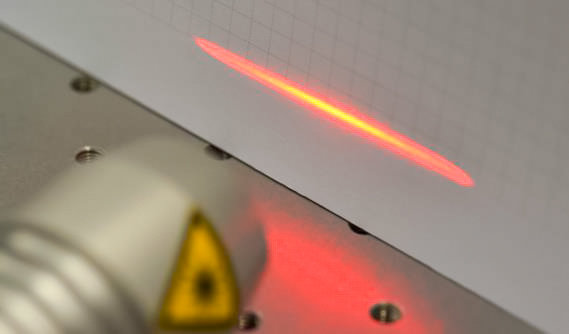
Line lasers are laser products that emit a line-shaped beam, i.e. thin and collimated in one dimension and highly divergent (fanning out) in the other dimension.
They are used for machine vision or projecting patterns on workpieces or as guideline on factory floors. As all laser products, line lasers must comply with the international laser products safety standard IEC 60825-1. We recently published a study on the extended retinal image that a line laser produces:
“Safety classification of line lasers as extended source”
Line lasers are a good example for extended sources, i.e. laser products that result in a certain extended retinal image when somebody looks into the laser beam. The image that would be formed on the retina can be measured with an imaging lens and a CCD camera, as “artificial eye”. Line lasers clearly exemplify why, for extended sources, IEC 60825-1 requires considering different eye accommodation positions – from relaxed viewing at infinity to accommodation to the beam waist in the diverging axis (the vertex of the line). When someone looks into a line laser, the eye naturally accommodates to infinity, resulting in a sharp line image.
However, for most line lasers, accommodation to the vertex of the line (near the line-shaping optics) produces a smaller and thus more restrictive retinal image. This illustrates again that the “apparent source” for safety classification may not be what we perceive when looking into the beam. Our study, performed by our accredited test house team, showed that accounting for the extended nature of line lasers can result in a factor of about 6 higher permitted laser power, i.e. factor 6 “brighter” line laser, as compared to treating a line laser as simple point source.